Research Insight · JintellarCore · April 2026
The Signal You Shouldn't Ignore
JPMorgan Chase, one of the world's most scrutinized financial institutions, operating at a scale few technology companies can match, recently published a detailed position on what it takes to secure the next generation of AI systems. Their conclusion is clear: the rules of AI security have fundamentally changed, and most organizations are not ready.
We are.
This article unpacks what JPMorgan Chase is calling for, why it matters across every regulated industry, and why JintellarCore was designed from the ground up to meet exactly this standard, before the industry caught up.
What JPMorgan Chase Is Saying
In their blog post Securing the Next Generation of AI Agents, JPMorgan Chase draws a sharp line between the AI of yesterday and the AI of today:
"AI has entered its next phase. For years, most AI systems informed decisions. Now, a new class of systems, AI agents, make decisions on our behalf. Agents do not just produce outputs; they take action."
This is the shift that changes everything. When an AI system moves from answering questions to executing actions, calling APIs, accessing data, triggering workflows, interacting with other systems, the entire security model has to be rebuilt from scratch.
JPMorgan Chase identifies three critical challenge areas that every enterprise deploying AI agents must address:
1. Software and Execution Risk
AI agents rely on orchestration layers, external tools, and integrations to get things done. The risk is not just in a single action: it's in how actions are sequenced and combined. Even individually authorized steps can produce unintended and dangerous outcomes when chained together. Security must operate at runtime, not just at build time.
2. Identity and Authorization
Agents operate using delegated authority. They act on behalf of users, systems, and other agents. JPMorgan Chase is direct: without clear identity boundaries and authorization controls, a single compromised agent can propagate risk across an entire environment. Machine-to-machine trust is now as critical as user authentication.
3. Data as an Attack Surface
AI agents blur the line between data and instructions. External inputs can influence agent behavior, not just its outputs. This creates new risks around data ingestion, interpretation, and reuse. Their prescription: data must be "policy-aware" at runtime, carrying labels that describe what it is, how sensitive it is, and what it is allowed to be used for, enforced wherever the data travels, with a complete auditable trail.
The Gap JPMorgan Chase Acknowledges but Cannot Yet Close
JPMorgan Chase has correctly identified the problem. Their framework is directionally sound. But identifying the destination is not the same as having a vehicle to get there.
The challenge for large institutions is structural. They are retrofitting security principles onto systems that were never designed to be agent-native. Bolt-on governance, patched orchestration layers, and post-hoc audit logs are the tools of an institution trying to catch up.
JintellarCore was not retrofitted. It was architected for this exact moment.
How JintellarCore Is Already There
Every security principle JPMorgan Chase is now calling for is native to JintellarCore's architecture, not added on, but designed in from the foundation.
Capability-Bound Security (CBS)
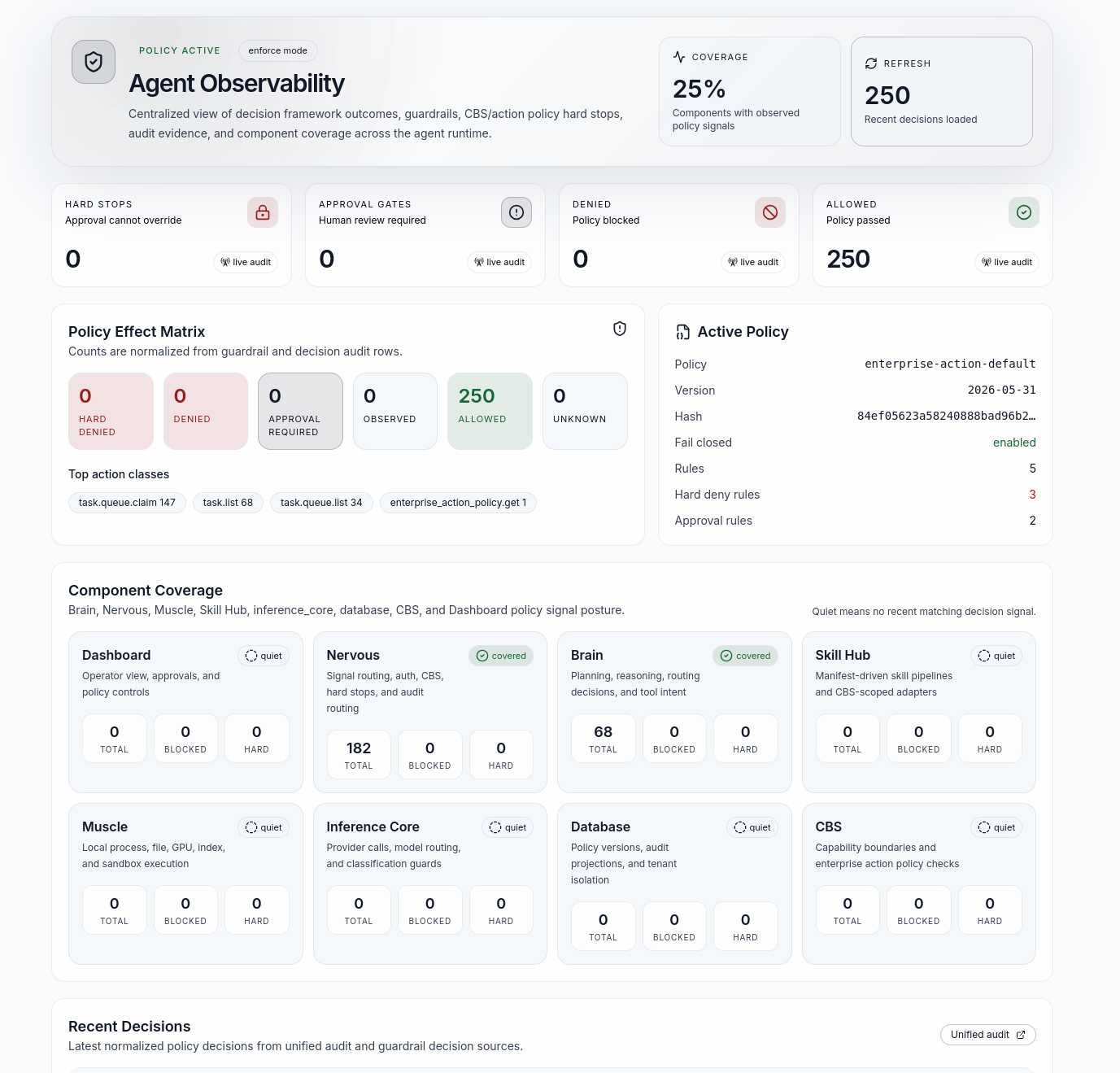
JintellarCore's Golden Rule governs every agent in the system: no component acts beyond its defined capability boundary. Skills are isolated, scoped, and constrained. A reading agent cannot write. A reporting agent cannot execute. Every agent knows exactly what it is allowed to do, and the system enforces it structurally, not by policy memo.
This is JPMorgan Chase's "authorization boundaries" principle, implemented at the architecture level.
Signal-Level Audit Trail
Every action taken by every agent in JintellarCore flows through a cryptographically consistent signal layer. The Nervous system, JintellarCore's central coordination layer, records what was requested, who requested it, what was executed, and what was returned. These are not logs added after the fact. They are the operating record of the system.
This is JPMorgan Chase's "tamper-evident, complete runtime records" requirement, built into the data flow itself.
Policy-Aware Data at Runtime
JintellarCore's data layer is designed to carry classification context with every payload. Sensitivity labels, access scope, and handling rules travel with the data, not stored separately in a policy document no one checks. Agents downstream know what they are receiving and what they are permitted to do with it before they act.
This is JPMorgan Chase's "policy-aware at runtime" requirement, implemented as a first-class system primitive.
Agent Identity and Delegated Authority
JintellarCore's multi-agent architecture separates identity from capability by design. Each agent has a defined role, a bounded scope, and a traceable identity within the signal chain. When agents interact with each other, Brain to Skill Hub, Skill Hub to Cloud Inference, each handoff is authorized, scoped, and recorded.
This is JPMorgan Chase's machine-to-machine trust requirement, not as a feature to be added, but as the baseline operating model.
No Hardcode. No Hidden State.
JintellarCore enforces a strict no-hardcode rule across every system component. Hostnames, credentials, model names, role definitions, sensitivity classifications: all externalized, all configurable, all auditable. This is not a style preference. It is a security stance. Systems with hardcoded values cannot be audited, cannot be governed, and cannot be trusted at enterprise scale.
Why This Matters Now
JPMorgan Chase is not alone in this assessment. The convergence of agentic AI, regulatory pressure, and escalating cyber risk is creating an inflection point across every regulated industry: financial services, healthcare, legal, government, and defense.
The institutions that will thrive are not those that move fastest to deploy AI. They are those that can prove their AI operates within defined boundaries, with complete accountability, at every point of execution.
That proof requires architecture. It cannot be audited into existence after the fact.
The direction JPMorgan Chase is pointing is the right one. The question for every enterprise AI initiative is whether their systems were built to travel in that direction, or whether they're still trying to find the road.
Closing Thought
JPMorgan Chase is doing something important by publishing this framework. They are telling the market what responsible agentic AI looks like. Enterprises, regulators, and technology buyers are paying attention.
JintellarCore exists because we saw this moment coming. The architecture was not designed to meet today's compliance requirements: it was designed to meet tomorrow's.
When JPMorgan Chase says the industry needs runtime governance, auditable agent records, capability-bound authority, and policy-aware data: they are describing what JintellarCore already delivers.
The standard is being set. We built to it before it was written.
JintellarCore is an autonomous AI platform built for enterprise environments where security, auditability, and regulatory compliance are non-negotiable. For more information, visit jintellarcore.com.
Reference
- JPMorganChase Technology Blog: "Securing the Next Generation of AI Agents" (March 2026)